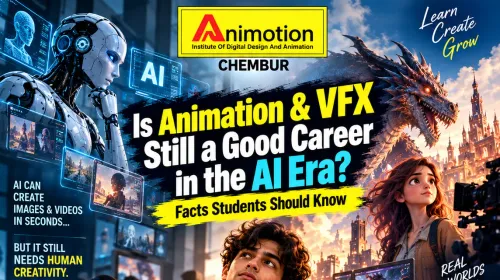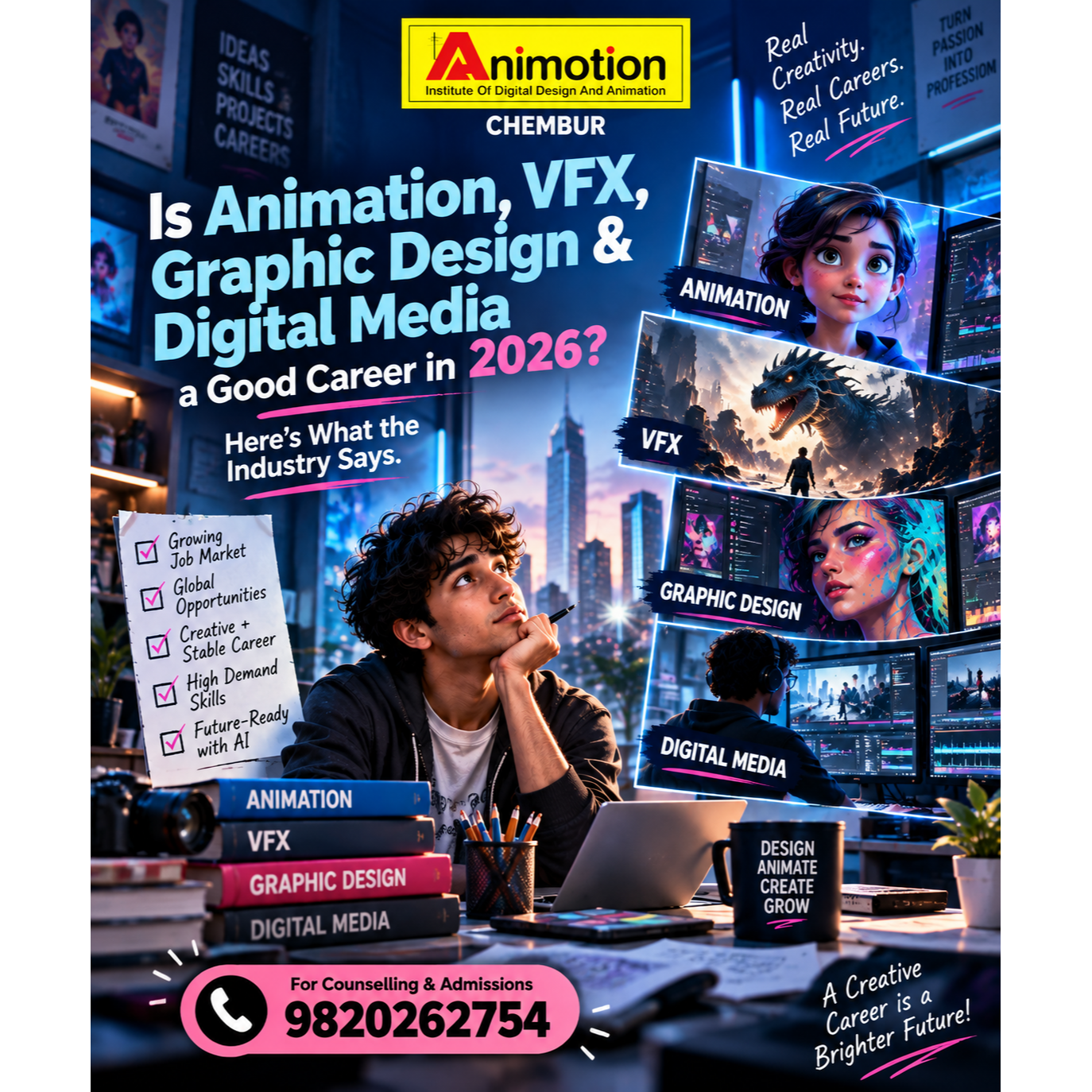
“Is there really a future in Animation, VFX, Graphic Design and Digital Media?”
This is one of the biggest questions students and parents should ask before choosing a creative course.
And the answer shouldn't come from an advertisement.
It should come from understanding the industry.
India's media and entertainment industry reached an estimated ₹2.78 trillion in 2025, growing about 9% year-on-year, according to the latest FICCI-EY report. Digital media became the largest segment, while digital advertising reached ₹947 billion. EY
But here's the important part:
Not every creative field is growing at the same speed.
Animation and VFX grew only modestly in 2025, according to the same report, while digital advertising and live events grew much faster. EY
This is exactly why students need to stop thinking about “one creative industry.”
There are many.
THE CREATIVE ECONOMY IS BIGGER THAN FILMS.
Think about how many things you see every day:
Instagram advertisements.
YouTube videos.
Netflix and OTT content.
Brand campaigns.
Mobile applications.
Websites.
Gaming.
Product videos.
Corporate presentations.
Digital advertisements.
3D visualisations.
Animated content.
Social media reels.
E-commerce creatives.
Every one of these requires some combination of design, storytelling, technology and communication.
WHERE CAN A STUDENT FIT?
GRAPHIC DESIGN
Brands need visual communication.
VIDEO EDITING
Businesses and creators need video.
MOTION GRAPHICS
Advertising and digital content need movement.
UI/UX
Digital products need usable experiences.
ANIMATION
Stories, characters and digital content need animation.
VFX
Film and digital production need visual effects.
DIGITAL MARKETING
Businesses need online visibility and customer acquisition.
GAME DESIGN
Interactive entertainment continues to evolve.
AND THEN THERE IS AI.
AI is not sitting outside these industries.
It is entering them.
EY reports that Indian media companies are incorporating GenAI into areas such as content creation and post-production, while its latest sector research notes that AI is increasingly embedded in VFX workflows. EY
So the question is not:
“Should I learn creative skills or AI?”
The smarter question is:
“How can I combine creative skills with AI?”
Imagine a future designer who can:
Think → Design → Generate → Edit → Refine → Present
Or an animator who can:
Concept → Storyboard → Build → Animate → Use AI → Refine → Deliver
That combination can be much more powerful than learning a single tool.
WHAT JOBS CAN STUDENTS EXPLORE?
Depending on their specialization and portfolio:
Graphic Designer
Motion Graphics Designer
Video Editor
3D Artist
Animator
VFX Artist
Compositor
UI/UX Designer
Digital Marketing Executive
Creative Content Specialist
Game Artist
3D Generalist
Freelance Creative Professional
There is no guarantee that completing a course automatically leads to any particular job.
But students who develop strong portfolios, practical skills and adaptability can position themselves for opportunities.
THE FUTURE IS NOT “AI VS PEOPLE.”
The future is increasingly becoming:
PEOPLE WHO KNOW HOW TO USE TECHNOLOGY WELL.
That is why students shouldn't fear AI.
They should understand it.
They shouldn't stop learning creativity.
They should strengthen it.
They shouldn't only collect certificates.
They should build portfolios.
At Animotion Institute of Digital Design & Animation in Sion, students can explore Graphic Design, Animation, VFX, Video Editing, Motion Graphics, UI/UX, Digital Marketing and Game Designing with an emphasis on modern digital workflows.
The creative industry is changing.
The tools are changing.
The opportunities are changing.
The question is:
Are your skills changing too?